Produce roof insulation components from EPS and Neopor in-house
Tapered boards, valley boards, hip boards, roof crickets, insulation wedges and custom parts produced directly in your own facility.
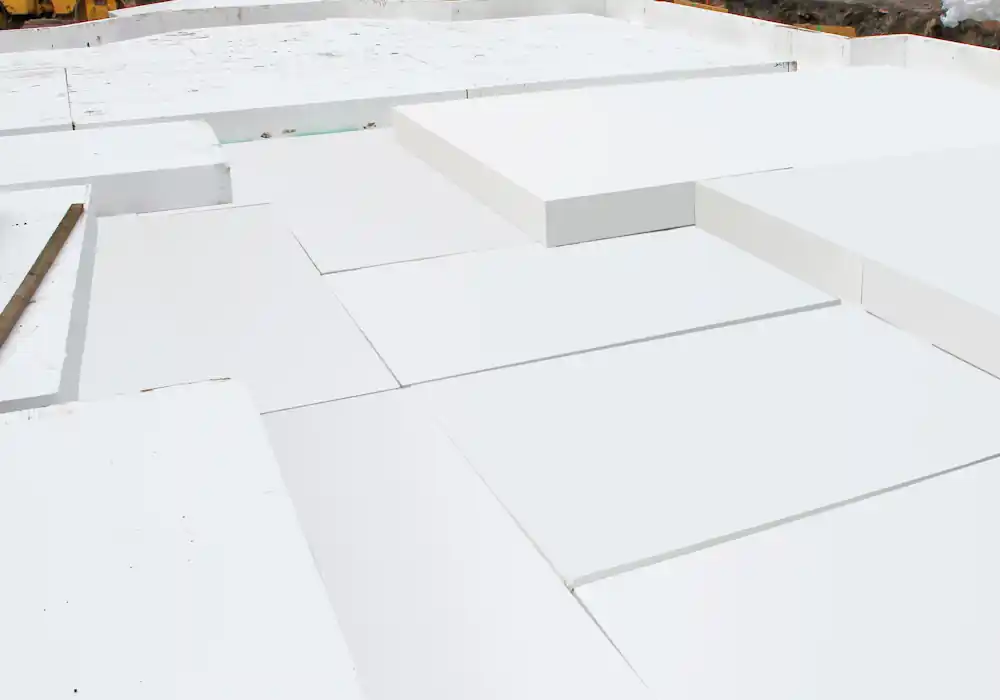

Everything the industry can produce, you can produce too.
Ordering finished roof insulation components from your supplier works.
And you should continue to do so, because no one can cut tapered boards more cost-effectively than an EPS manufacturer who earns on both the material and the cutting.
But what happens when a part is missing or gets damaged while unloading at the job site?
Then the familiar process begins: call the supplier, send pictures, provide dimensions, answer questions and wait for a replacement.
In the worst case, work comes to a stop.
With our machines, you make yourself independent of that.
Missing or damaged roof insulation components can simply be produced quickly in-house.
And once the machine is there anyway, you can also turn leftover boards from previous jobs that are sitting in your yard into components for new roofs.
Material you have already paid for becomes new roof insulation components for the next project.
And before you know it, you are no longer producing only replacement parts and custom parts, but complete roof insulation packages yourself.
Your existing supplier may then no longer deliver only finished roof insulation components, but also the EPS blocks you need to make them.
At least for the roofs where it makes sense for you.
Want to know what you can produce too?
With the right machine setup, you can produce these roof insulation components yourself:

Tapered boards

Valley and hip boards

Roof crickets

Insulation wedges

Start small and expand step by step
For complete roof insulation production, you need more than one machine.
Not because one machine cannot do enough, but because different production steps often need to happen at the same time.
Just like in your workshop: you do not have only one cordless drill for every job.
But you do not have to start with the complete production setup.
One machine is enough to get started – and your roof insulation production can grow step by step later.
What do I actually need?
RoofCut – one machine for everything
You do not need more to get started.
With the RoofCut, you can cut EPS blocks to length, cut tapered boards and produce all roof insulation components from EPS and Neopor.
Valley and hip boards, roof crickets, insulation wedges and custom parts – all with one machine.

CT2500S – when production grows
When your volume of boards and tapered boards increases, the CT2500S is the next step.
While the RoofCut prepares EPS blocks or cuts valley boards, roof crickets and other roof insulation components, the CT2500S produces boards and tapered boards in parallel.
This takes the load off the RoofCut and moves tapered-board production to the CT2500S.
And the best part: the CT2500S works without a computer. Place the block and cut. It could hardly be simpler.

GT1300S – when cutting blocks to length takes too much time
When you notice that cutting blocks to length is tying up the RoofCut and keeping it from doing what it does best – cutting roof crickets as well as valley and hip boards – it is time for the GT1300S.
The GT1300S takes over cutting EPS blocks to length and keeps the RoofCut available for actual roof insulation production.
The GT1300S does not need a computer either. Load the block, press the button, cut to length.

SHD2000S – when EPS offcuts start piling up
The more custom cuts you produce, the more leftover material you generate.
Of course, the RoofCut can also cut leftover pieces into smaller sections. But at some point, it is better used producing roof insulation components.
That is when the SHD2000S takes over.
Offcuts in, cut down, pass them on.
The SHD2000S turns bulky EPS offcuts into manageable pieces that are easier to collect, store and send for recycling.


A machine is only as good as its software.
You can start cutting tapered boards right away. Very easy.
Cutting valley and hip boards? No problem either.
Roof crickets are more demanding. They take a little more practice.
Operation is so straightforward that most of our customers do not need separate employee training.
Many learn the applications themselves step by step. Our instructions explain everything they need.
If you want to start production immediately, however, we recommend 1–2 training days with our application technicians – at our facility or optionally on-site at your company.
Does it pay off?
If you compare purchase price alone, probably not. In many cases, your supplier can provide complete roof insulation packages at a lower price.
But calculate it another way:

What does it cost when an employee cuts replacement boards by hand?
Manual cutting takes time and ties up an employee who could be doing other work during that time.

What does it cost when work stops because a roof insulation component is missing?
Employees wait, other work gets pushed back and, in the worst case, the job site comes to a standstill.

What does it cost to store leftover boards from previous jobs and dispose of them later?
You have already paid for the material. Then you pay again for storage and disposal.

What does it cost to depend on lead times and availability for custom parts?
When a part is missing, the familiar process starts again: make the call, send dimensions, answer questions and wait for delivery.
Interested?
See the machines live at our facility.
We will show you directly at the machine how easy it is to produce your own roof insulation components.
Test the machines live
Consulting
personal and
professiona

Testing
Experience our
machines live
Planning
Customized solutions
for your production.

Support
there for you even
after your purchase